Table of Contents
- Big Brake Kits for Supermoto: What They Actually Change
- Stock Brakes vs. a Supermoto Brake Upgrade: Performance Comparison
- When a Supermoto Oversized Front Rotor Makes Sense
- Supermoto Brake Pads and Lines: The First Upgrade Most Riders Need
- Supermoto Brake Fade: Why Bigger Isn’t Always Cooler
- Fitment, Compatibility, and Installation Checklist
- Cost of Ownership and When to Skip the Big Brake Kit
- Conclusion: Are Big Brake Kits Worth It for Your Riding?
- Frequently Asked Questions
Last Updated: October 18, 2026
Big Brake Kits for Supermoto: What They Actually Change
If you have asked whether big brake kits are worth it for supermoto, the short answer: they change how the front of the bike feels more than how fast you can stop.
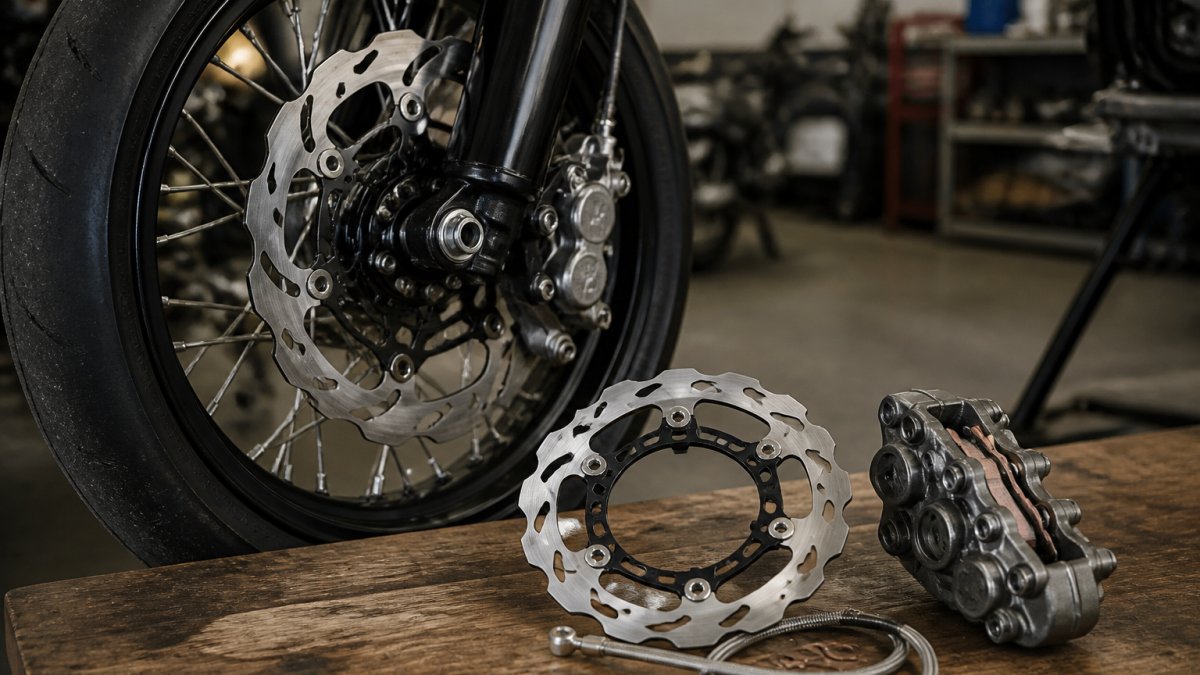
A big brake kit is a matched package: a larger rotor, a caliper spacer or new caliper, and sometimes a new master cylinder.
That is the real benefit. Not shorter stopping distances on the first stop, but the same strong stop on the tenth lap.
What most guides miss: a supermoto is already light, with a single front disc doing most of the work. Adding rotor diameter helps, but the tire contact patch and front suspension often run out of grip before the brake runs out of power.
Stock Brakes vs. a Supermoto Brake Upgrade: Performance Comparison
Stock brakes on a converted dirt bike are usually good enough for one hard stop. The gap shows up on the third, fourth, and fifth stop in a row.
Here is how the two setups differ in practice, with the mechanism behind each row:
Factor | Stock Setup | Supermoto Brake Upgrade | Why It Happens |
|---|---|---|---|
Initial bite | Soft, forgiving | Sharper, more direct | Larger rotor radius and a bigger caliper piston area multiply the same lever force into more clamping force at the disc |
Brake feel | Vague at the lever | Firmer, more feedback | Less compliance in the system, stiffer caliper, braided line, and a master cylinder matched to the new caliper volume |
Fade on repeated stops | Noticeable after a few laps | Delayed, more consistent | More rotor mass and surface area shed heat faster, so pad and fluid temperatures stay below their limits longer |
Weight | Lighter | Heavier at the front | A larger rotor and caliper add unsprung mass at the wheel, which the fork has to control |
Cost | Lowest | Higher, plus install time | Rotor, caliper or spacer, bracket, lines, fluid, and labor add up beyond the kit price |
Best for | Street and casual riding | Track days and hard use | Only repeated hard braking generates the heat a big kit is designed to manage |
Lever effort drops with a bigger setup, and modulation gets easier once you adjust. But a sharper initial bite can catch a rider out on cold tires, so the first session on a new kit should be about learning the lever, not chasing lap times.
What Actually Changes on a Supermoto
A supermoto is light, runs a single front disc, and spends most of its braking time on a narrow, hard-compound tire. That changes the comparison in three ways:
- The tire is often the limit, not the brake. On a light bike with a street-legal supermoto tire, the contact patch can run out of grip before the caliper runs out of clamping force. A bigger kit does not create grip; it changes how easily you can ask for it.
- The fork is the second limit. A stock or lightly revalved fork dives under hard braking. A big kit that lets you brake later and harder exposes weak fork damping and can make the bike feel worse until the suspension is sorted.
- The riding surface changes the math. On a kart track, braking is short, hard, and repeated, the exact condition a big kit is built for. On a loose surface, a sharper initial bite is a liability because the front can lock before the tire hooks up.
A Repeatable Test You Can Run Yourself
You do not need a test track. Find a safe, empty stretch of pavement and run this comparison on your current setup, then repeat it after any change:
- Warm-up stop. Ride to a steady speed, apply the brake firmly but not at the limit, and come to a full stop. Note the lever feel.
- Baseline stop. From the same speed, brake hard to a stop and mark the point where you began braking. Repeat three times, marking each start point.
- Measure the spread. The distance between your first and last start mark tells you how much the system is fading. A stock setup typically shows the marks creeping earlier as heat builds; a sorted big kit keeps them closer together.
- Note lever effort. Pay attention to how much hand force the same stop requires on the last run versus the first. A soft, long lever on the last run is the clearest sign the system is heat-soaked.
It is not lab-grade, but it is repeatable and tells you whether you have a fade problem or a feel problem, different problems with different fixes, and only one calls for a big brake kit.
When a Supermoto Oversized Front Rotor Makes Sense
A supermoto oversized front rotor makes sense when your riding involves repeated hard braking from speed, not the occasional stop.
The oversized rotor adds use, so the same lever pull produces more stopping force, letting you brake later with less hand fatigue.
But there is a catch. A larger rotor is heavier and more exposed, so on a bike that sees drops or light off-road use it is a liability.
Supermoto Brake Pads and Lines: The First Upgrade Most Riders Need
Before you spend on a big kit, start with supermoto brake pads and stainless lines, the cheapest way to sharpen brake feel, and most riders feel the difference on the first ride.
Here is the order we recommend:
- Pads first. A quality sintered pad gives more bite and better heat tolerance than a stock organic pad.
- Lines second. Braided stainless lines stop the rubber line from expanding under pressure, so the lever feels firmer.
- Fluid third. Fresh, correct-spec fluid keeps the system from fading when it gets hot.
A common mistake is buying a caliper upgrade to fix a soft lever that a fresh fluid flush would have solved. Check the simple stuff first.
Supermoto Brake Fade: Why Bigger Isn’t Always Cooler
Supermoto brake fade comes from heat, and heat comes from repeated hard braking with little airflow. A bigger rotor helps but is not a free pass, fade still happens if pads, fluid, and riding style are not matched to the setup.
The honest trade-off: a big kit buys you more time before fade, not immunity from it. Riders who drag the brake instead of braking hard and releasing will cook any setup.
Heat management is a riding skill as much as a hardware choice. Short, hard braking zones with a full release between them keep the system cooler than long, dragging stops.
Fitment, Compatibility, and Installation Checklist
Fitment is where most supermoto brake upgrades go wrong. A kit that fits one bike may not fit yours, even within the same model family. Caliper mounts, rotor offset, and wheel spacing all vary.
Run this checklist before you order:
- Confirm your exact year, make, and model, not just the model name
- Check the rotor diameter and offset match your fork and caliper mount
- Verify the caliper spacer or bracket is included and correct
If you are not a mechanic, get a shop to check the fitment before you buy. Ordering the wrong bracket wastes weeks.
Cost of Ownership and When to Skip the Big Brake Kit
The full cost of a big brake kit is more than the box price. Add pads, fluid, lines, install time, and the chance of a bracket that does not fit. That total is what you should weigh, not the sticker on the kit.
What the Total Actually Includes
Break the cost into four buckets before you compare anything:
- The kit itself. Rotor, caliper or caliper spacer, bracket, and mounting hardware. Confirm the bracket is included, a missing bracket can mean a second order and another wait.
- The supporting parts. Pads matched to the new rotor, braided stainless lines if the kit does not include them, fresh fluid, and any master-cylinder change the caliper bore calls for.
- Installation. If you do the work yourself, budget a full afternoon for fitment, bleeding, and a test ride. If a shop does it, get the labor estimate in writing before you order, because fitment surprises add hours.
That running cost is the part riders forget. A kit that saves you fade on track day can cost more per season in pads and rotors than the stock setup ever did, not a reason to skip it, but a reason to budget for it.
Diagnose Before You Buy
Before you spend on a kit, work through the problem from cheapest to most expensive. Most soft-lever complaints are solved long before a big kit is needed:
- Is the fluid fresh? Old fluid absorbs moisture and boils at a lower temperature. A flush is the cheapest fix and the most commonly skipped one.
- Is the system bled properly? Air in the line feels exactly like a failing master cylinder. Bleed it again before you replace anything.
- Are the pads right for the use? A stock organic pad fades early under hard use. A sintered pad matched to your rotor is the next step.
- Are the lines original? Rubber lines expand under pressure and soften the lever. Braided stainless lines are a small cost with a large feel change.
- Is the master cylinder matched? A master cylinder with the wrong bore for the caliper gives a long, vague lever no matter how big the rotor is.
If steps one through five do not fix the problem, you have a genuine capacity issue, and that is when a big kit earns its place.
When to Skip the Big Brake Kit
Skip the big kit when:
- You mostly commute or ride casually on the street
- Your stock brakes already feel firm and consistent
- You have not yet upgraded pads, lines, and fluid
For those riders, a pad and line upgrade delivers most of the feel for far less money and hassle.
Where a big kit earns its keep is repeated hard braking at the track. If you are doing track days, time attack, or competition, the consistency is worth it. For everyone else, the basics come first.
Conclusion: Are Big Brake Kits Worth It for Your Riding?
So, are big brake kits worth it for supermoto? For track and aggressive riders, yes. For street and casual riders, usually not until the basics are done.
The upgrade that pays off first is almost always pads, lines, and fresh fluid. A big kit is the last step, not the first.
If you are building a supermoto and need wheels, conversion parts, or brake components that actually fit your bike, shop now at Moto X Industries and get the right parts the first time.
Frequently Asked Questions
Are brake upgrades worth it on a supermoto?
It depends on how you ride. For street riding and occasional track days, fresh supermoto brake pads, stainless lines, and fresh fluid often deliver the biggest improvement per dollar. A supermoto brake upgrade with a larger rotor and better caliper becomes worthwhile when you push hard repeatedly, such as time attack or competition, where stock brakes overheat and fade. Match the upgrade to your actual use, not to the spec sheet.
Does a larger front rotor improve supermoto braking?
A supermoto oversized front rotor increases leverage and heat capacity, which can improve initial bite and reduce fade during repeated hard braking. The trade-off is added unsprung weight, a greater chance of damage in a fall, and the need to verify caliper and wheel compatibility. It is most beneficial for track riding and aggressive street use; for casual riding, a pad and line upgrade may be enough.
Do supermoto big brake kits cause more brake fade?
Not inherently. A well-matched big brake kit with adequate cooling and the right pad compound usually reduces supermoto brake fade because the larger rotor and caliper manage heat better. Problems arise when riders mix mismatched components, use street pads on the track, or fail to bed pads correctly. Fade is more about heat management and pad choice than rotor size alone.
Can you install a big brake kit with stock supermoto wheels?
Often yes, but fitment varies by bike and kit. Check rotor bolt pattern, offset, caliper mounting, and wheel spoke clearance before ordering. Some kits require specific wheel widths or spacers, and a few need a different master cylinder to feel balanced. If you are unsure, confirm the exact model and year with the seller, and factor in the cost of lines, fluid, and possibly a new master cylinder.