Last Updated: October 30, 2026
Quick Summary
A race-ready supermoto racing gear kit includes a helmet with a clean, uncracked shell, goggles with clear and tinted lenses, a one-piece leather suit or armored riding suit, hard-knuckle gloves, ankle-support racing boots, a back protector and body armor, and base layers. Check your track’s rule book first, since requirements vary by venue.
- Road America requires a MyLaps MX Orange transponder on the upper fork leg.
- Replace a dropped or damaged helmet shell rather than repairing it.
- Carry one clear and one tinted lens and check goggle strap and foam each race weekend.
- Inspect helmet, suit, gloves, boots and back protector before every race weekend.
- Keep separate street and race kits instead of one compromise setup.
Table of Contents
- Essential Supermoto Racing Gear for 2026
- Track Day Motorcycle Gear Requirements and Supermoto Helmet and Goggles
- How to Inspect Motorcycle Racing Gear and Street Motorcycle Gear for Commuting
- Frequently Asked Questions
Essential Supermoto Racing Gear for 2026
Building a supermoto racing gear setup in 2026 starts with one question: where will you actually ride? Gear depends on how and where you ride. If your riding to work or around town you would use street bike gear. If your racing most tracks have their own guidelines.
The 2026 Road America Supermoto Series rule book shows how specific track rules get, it requires a MyLaps MX Orange transponder on the upper fork leg. Check your track’s rule book first, then build your kit around it.
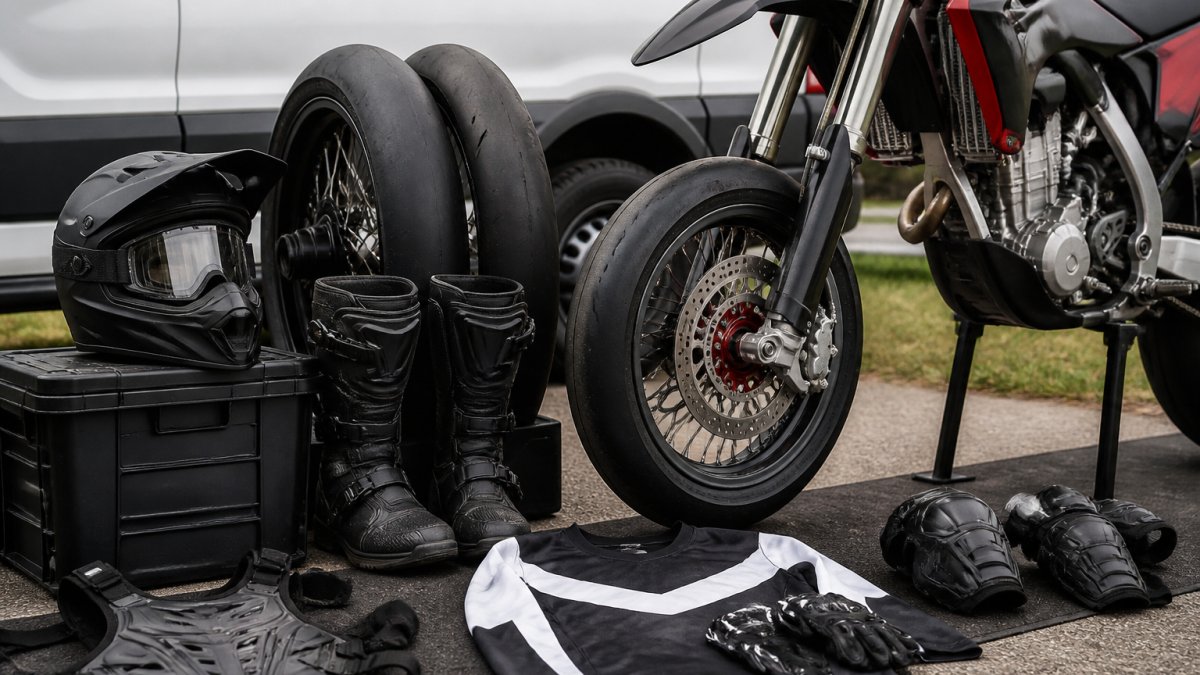
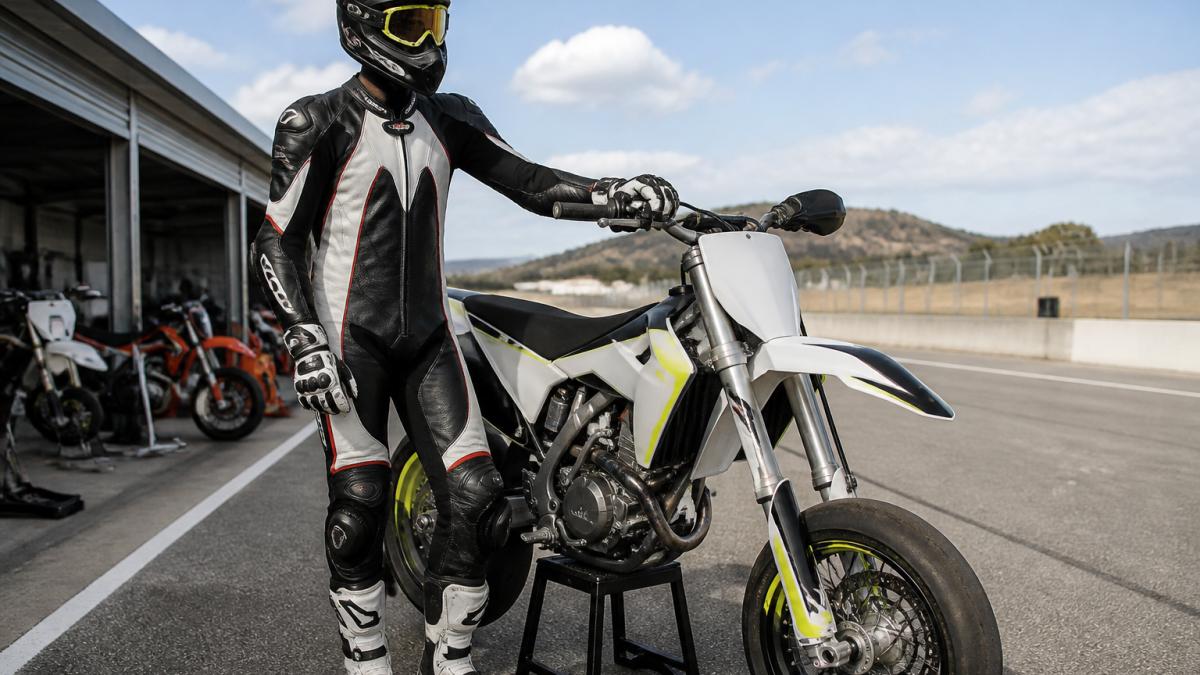
A race-ready kit includes a helmet with a clean, uncracked shell, goggles with clear and tinted lenses, a one-piece leather suit or armored riding suit, hard-knuckle gloves, ankle-support racing boots, a back protector and body armor, and base layers for heat and sweat control. Alpinestars lists eight equipment categories in its 2026 beginner motocross checklist, and the list holds up well for supermoto too. Browse our full supermoto category to see how these pieces come together for race builds.
Here is the race-ready kit the article lists, piece by piece.
| Gear item | Key detail |
|---|---|
| Helmet | Clean, uncracked shell; replace if dropped or damaged |
| Goggles | One clear and one tinted lens; check strap and foam |
| Suit | One-piece leather suit or armored riding suit |
| Gloves | Hard-knuckle gloves |
| Boots | Ankle-support racing boots |
| Protection | Back protector and body armor |
| Base layers | For heat and sweat control |
| Transponder | MyLaps MX Orange on upper fork leg at Road America |
Track Day Motorcycle Gear Requirements and Supermoto Helmet and Goggles
Track day motorcycle gear requirements vary by venue, so treat the track’s rule book as the final word. A full-face helmet with current safety certification is the baseline; a dropped or damaged shell should be replaced, not repaired.
Goggles are not an afterthought. Supermoto riders face dust, tire rubber, and bright sun in one session, so carry one clear and one tinted lens and check the strap and foam before every race weekend.
Start with our helmets selection and pair it with goggles that seal properly against the shell.
How to Inspect Motorcycle Racing Gear and Street Motorcycle Gear for Commuting
Learning how to inspect motorcycle racing gear takes ten minutes and saves a bad weekend. Check the helmet for cracks, loose liner, and a worn chin strap; the suit for seams, zippers, and worn patches at knees and elbows; gloves for split seams or flattened knuckle guards; boots for soles, buckles, and ankle support; and the back protector for cracks and flat fit.
Street motorcycle gear for commuting follows the same logic with a different priority list: abrasion resistance and visibility matter more than ventilation. Readers comparing setups can learn the supermoto vs motocross suspension differences. Keep two separate kits rather than one compromise.
Watch out: reusing a crashed helmet or a suit with torn seams is a mistake to avoid. Impact protection that has already done its job once will not do it again.
Frequently Asked Questions
What gear do you need for supermoto racing?
A complete kit typically covers helmet, boots, goggles, jersey and pants, gloves, body armor, neck support, and base layers. For supermoto specifically, a one-piece leather suit and a back protector are common additions. Most tracks publish their own guidelines, so check with the organizer before you buy. Gear choice also depends on whether you are racing or commuting.
Can you wear street motorcycle gear for supermoto racing?
It depends on the track. Street motorcycle gear for commuting prioritizes weather protection and visibility, while racing gear focuses on abrasion resistance and impact protection. Some organizers accept street gear with added armor; others require a one-piece leather suit. Confirm the track’s rules first.
How should you inspect motorcycle racing gear before a race?
Check each item before every event. Look for cracked or compressed helmet foam, frayed seams, worn glove palms, and boot soles separating from the upper. Confirm armor stays in place and zippers close fully. Replace any piece that has taken a hard impact, even if damage is not visible. Regular inspection matters more than any label.
Your gear is only as good as the parts bolting it to the bike, and a race weekend exposes every weak point. At Supermoto wheels and tires, we stock the components that hold up under repeated track use, including specialized supermoto conversion kits and a wide range of parts for electric bikes like Surron and Talaria. Get started with Supermoto wheels and tires and build a kit that is ready for the grid, not just the driveway.
