Table of Contents
- Does a Larger Sprocket Increase Acceleration?
- Motorcycle Sprocket Gear Ratio Calculator: Understanding Final Drive
- How to Choose the Right Sprocket Size
- The Trade-Off Between Torque and Speed
- Chain Length and Speedometer Calibration: The Gotchas
- Off-Road vs. Street: Different Rules
- Common Misconceptions About Sprocket Sizes
- How to Calculate Sprocket Changes
- Frequently Asked Questions
Last Updated: September 29, 2026
Does a Larger Sprocket Increase Acceleration?
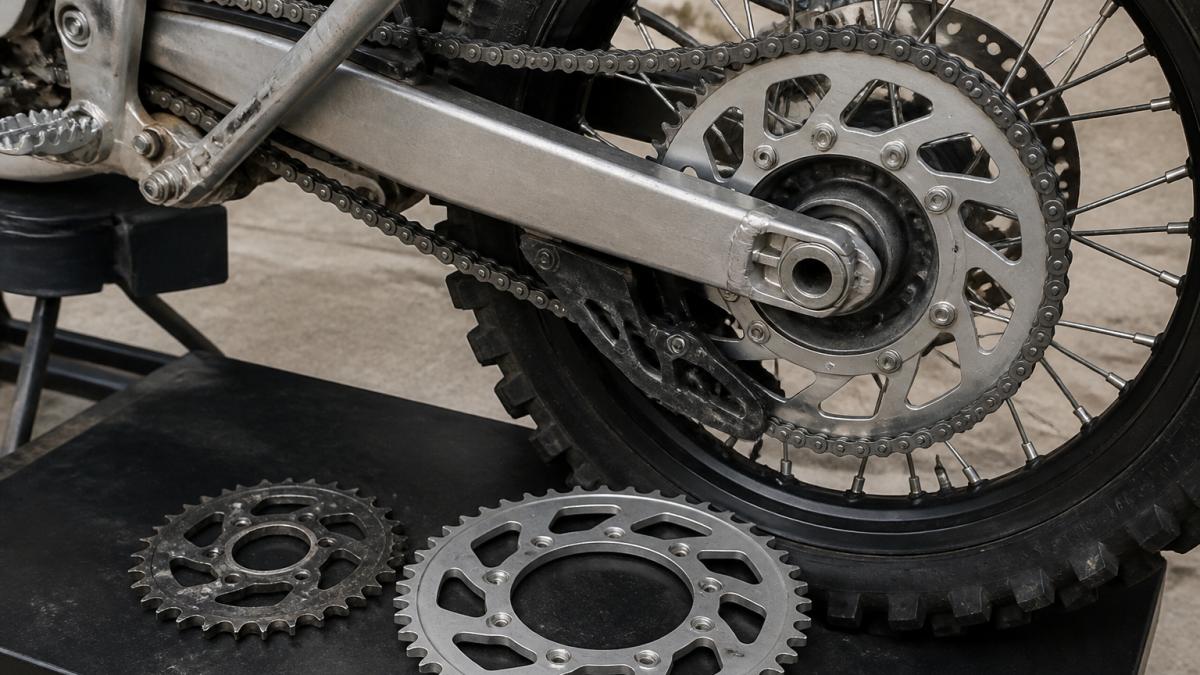
Yes, does a larger sprocket increase acceleration? It does. Adding teeth lowers your gear ratio, multiplying torque at the rear wheel for harder pull out of corners, but you lose top-end speed.
Motoxindustries.com breaks down how that swap works and what riders overlook before ordering parts.
A larger rear sprocket is the cheapest way to wake up a sluggish bike, but it raises cruising RPM, wears the chain faster, and throws off the speedometer.
Motorcycle Sprocket Gear Ratio Calculator: Understanding Final Drive
A motorcycle sprocket gear ratio calculator shows how a tooth change affects final drive before you buy: divide rear teeth by front teeth.
Lower ratio means more top speed and slower acceleration; higher ratio means harder acceleration and less top speed.
A 14-tooth front and 42-tooth rear gives a ratio of 3.0. Swap the rear to 45 and it jumps to 3.21, roughly 7% more mechanical advantage.
A larger rear sprocket increases acceleration because it forces the engine to spin faster for the same road speed, delivering more torque to the rear wheel.
How to Choose the Right Sprocket Size
Choosing the right sprocket size starts with one question: what do you actually ride?
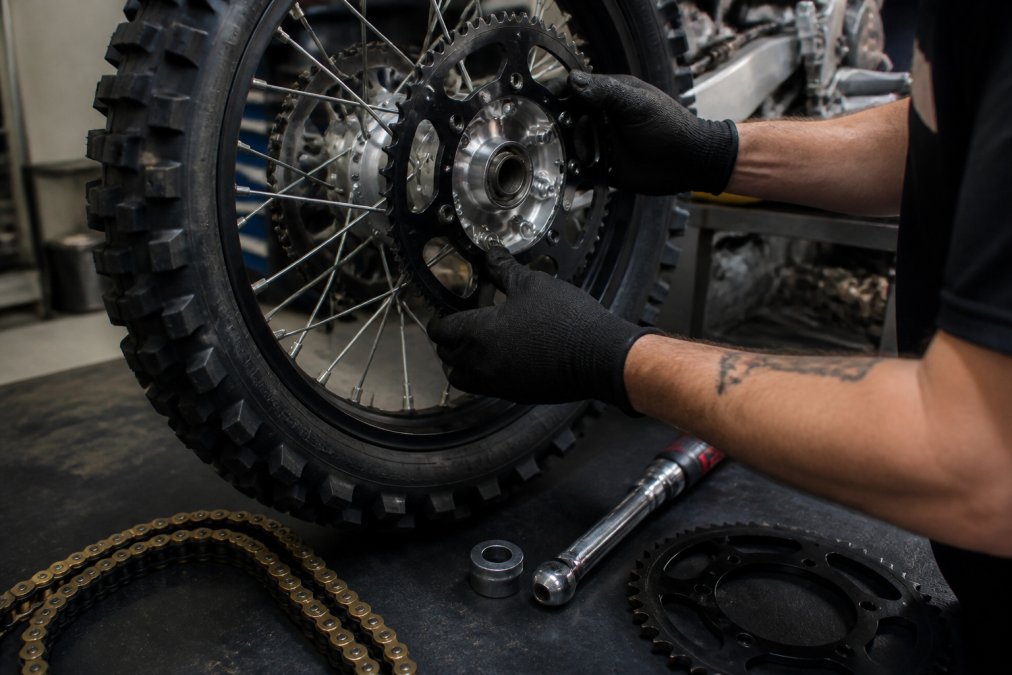
Write down your stock gearing, pick your goal, add 1-3 rear teeth for acceleration, drop 1 front tooth for a bigger jump (worth about 3 rear teeth), and check chain length, a bigger rear sprocket usually needs a longer chain or axle adjustment.
|
Goal |
Change |
Effect |
Best For |
|---|---|---|---|
|
Harder acceleration |
+2 to +4 rear teeth |
Quicker pull, lower top speed |
Trail, tight tracks |
|
Bigger acceleration jump |
-1 front tooth |
Roughly equal to +3 rear teeth |
Woods riding, hill climbs |
|
More top speed |
-2 to -3 rear teeth |
Higher top speed, slower launch |
Open desert, highway |
The Trade-Off Between Torque and Speed
Every sprocket change is a swap: you gain acceleration and give up top speed.
A larger rear sprocket increases acceleration by raising engine RPM at any given speed, the bike hits its power band sooner and corners feel sharper.
But at highway speed the engine screams, vibration rises, and fuel range drops.
Off-road and supermoto riders usually favor acceleration; dual-sport riders often run two rear sprockets and swap them by season.
Chain Length and Speedometer Calibration: The Gotchas
Two things bite riders after a sprocket swap: chain length and speedometer error.
Chain length: A bigger rear sprocket pulls the axle forward; if the chain is near its limit it won’t fit, so you’ll need a longer chain or more links.
Speedometer error: The speedo reads off the wheel, not the engine, so gearing changes usually does not throw it off. There are some bikes that run the speedo off of the front sprocket. Changing the front sprocket will change your speedometer slightly.
Off-Road vs. Street: Different Rules
Off-road riders almost always gear for acceleration. Loose dirt, steep climbs, and tight trails reward low-end grunt.
Street and supermoto riders face a split decision: shorter gearing is fun around town but annoying on the highway, so most builds land on a mild 1-2 teeth up on the rear.
Common Misconceptions About Sprocket Sizes
Myth: A bigger rear sprocket adds horsepower. It doesn’t, it changes how existing power reaches the wheel.
Myth: More teeth always means faster. More rear teeth means quicker, not faster. Top speed usually drops.
Myth: You can change gearing without touching the chain. Sometimes, but big changes usually need a new chain or link adjustment.
Myth: Front and rear sprocket changes are the same. One front tooth is worth about three rear teeth.
How to Calculate Sprocket Changes
Divide rear teeth by front teeth, then compare old and new ratios, the percentage change tells you how much acceleration and top speed will shift.
Example: stock 14/42 = 3.00. New 14/45 = 3.21. That’s about a 7% change.
For a bigger jump, drop one front tooth: 13/42 = 3.23, almost the same as 14/45 but harder on the chain.
Gearing is one of the few mods that changes how a bike feels for very little money.
Frequently Asked Questions
What size sprocket is best for acceleration?
There is no single best size, but the rule is simple: a larger rear sprocket or a smaller front sprocket increases acceleration. Adding 2-3 teeth to the rear is a common starting point. Use a motorcycle sprocket gear ratio calculator to see how a change shifts your final drive ratio before you buy.
How much difference does a 1-tooth change on the rear sprocket make?
One tooth on the rear is a small change, often about a 2-3 percent shift in final drive ratio. You may notice slightly quicker acceleration or a small drop in top speed, but many riders cannot feel it. For a clear difference, change 2-4 teeth at the rear or drop 1 tooth at the front.
Does a larger rear sprocket increase top speed?
No. A larger rear sprocket lowers your gearing, which boosts acceleration and reduces top speed. To raise top speed, you go the other way: a smaller rear sprocket or a larger front sprocket. The trade-off between torque and speed is the core decision in any dirt bike gearing guide.